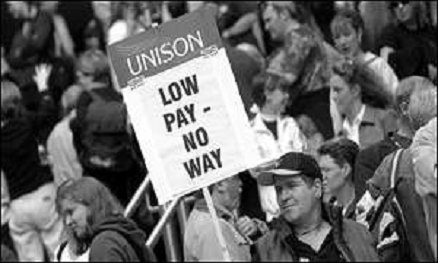
Unions Reject
Paltry Pay Offer
In response
to the trade unions' national pay claim of a flat rate increase
of £1,733 or 6% (whichever is higher), the employers have
offered a measly 3% flat rate.
All three trade
unions involved in the bargaining process are recommending that
their members reject the offer, saying industrial action may be
the only way to improve the offer.
In rejecting
the offer, the trade unions said that with inflation at 2.6%, the
tiny pay rise would do nothing to close the ever-widening gap between
pay in the private sector and pay in local government, and nothing
to end the chronic problem of low pay. Over 2/3rds of the local
government workforce earn less than the Council of Europe's decency
threshold of £14,559, whilst the average national wage is
over £21k.
UNISON Manchester
Branch Secretary Mo Baines said, "3% is an insult. Local Government
staff are fed up with being the cindarellas of pay awards. I urge
everyone to reject this paltry pay offer. "
35 hours for
all in view
Agreement was
reached with the City Council in December to seek to reduce working
hours down to 35 for all, as reported in the last edition of the
Mancunion. Branch Secretary Mo Baines said,
"the deal
would mean that employees currently working 37 hours will have their
hours cut to 36.5 with no loss in pay by April this year, whilst
part timers (of 37 hours) receive an increase in their hourly rate.
And obviously, those working 35 hours will not have their hours
increased."
Over the next
three years, half hour reductions will harmonise the workforce on
35 hours for all.
"Tough
negotiations are continuing, but following the December agreement,
it is imperative that Branch negotiators are able to make sure that
the 35 hours for all campaign becomes a reality. This is crucial
because the way in which working hours are reduced will help UNISON
and the Council deal with complex issues like bonus, the low pay
supplement and other pay issues."
Calling time
on overtime?
The Council
has long held the view that overtime premium payments are no longer
compatible with a 'modern working environment.' Many Best Value
reviews have looked at the provision of Council's services outside
of the 9 - 5 Monday to Friday norm. In the private sector, there
is a growing trend to employ people on 'flat rate' contracts that
would in the past have attracted premium rates. For example, shop
workers now commonly work a Sunday at the same pay rate as for a
weekday.
Mo Baines, UNISON
Branch Secretary, acknowledges that some services will always require
24 hour cover, such as those provided by UNISON members in Social
Services, but rejects the idea that all staff should be conditioned
to a 24/7 McJob employment culture.
"UNISON
recognises that people now have greater expectations of their public
services, but just what calls are made on the Council outside of
normal hours? With the obvious exceptions in some front line services,
the idea that the public is queuing up to get into the town hall
on a Sunday is simply ridiculous. In fact, with greater and more
innovative use of information and communication technologies, we
should be capable of limiting the time staff are expected to work
irregular or late hours whilst actually improving services."
"We are
not dinosaurs' but the reality is that if trade unions simply allow
all working hours to be deregulated, it is the employees who will
suffer, as well as the services they deliver, despite all the fluffy
rhetoric of Work-Life Balance policies."
"Quality
time with family and friends, caring for dependants or undertaking
lifelong learning must not be seen as a luxury. It should be a basic
right in a modern society. A 24/7 employment culture is not 'new',
it is a regressive step that take workers back a century."
UNISON wishes
to see any work outside of the 'norm' be regulated and based on
proven need. It is clear in some sections, such as in the Education
Department, that it is the high levels of unfilled vacancies that
exaggerate overtime costs. UNISON is pushing for clear justifications
for out of hours working practices as well as a review of how the
Council could move to premiums based on 'rest day' or 'short notice'
overtime working.
 Positively
Public Meeting Positively
Public Meeting
Contrary to
what you might be led to believe, not every politician and not even
many Labour MPs believe in privatising our public services.
At a packed
meeting in February, Branch Secretary Mo Baines joined ex-UNISON
General Secretary Rodney Bickerstaffe and Manchester Central MP
Tony Lloyd in outlining a vision for world class public services
in the UK.
All three speakers
agreed that well funded services delivered by highly trained and
well paid staff and which are democratically accountable to and
owned by service users are proven as the most efficient and effective
way of providing decent public services.
PFIs and PPP
have been shown to be far more expensive than standard, proven forms
of public sector investment. Not only does the private sector have
to borrow at higher rates than Government, and profit need to be
made, but the private company consortiums (or is that cartels) involved
in bidding for hospital, school and housing contracts often refuse
to take any risks attached with the 25 to 30 year long contracts.
Further, as
Rodney Bickerstaffe stated, "there should be no room in our
society for extracting profit from the ill, from the needy and from
our children's education system." If you want to know more
about UNISON's Positively Public camapaign, click the link on our
website
…STOP
PRESS…
Research from
the Cardiff Business School raises major questions over how far
public-private partnerships should be allowed to go in delivering
public services. The report states that handing services to the
private sector leaves local authorities "hollowed out"
and at the mercy of an imperfect marketplace, which destroys local
government's ability to respond to changing targets and priorities.
Whose Care
Trusts?
As many social
services employees will be aware, the new Health and Social Care
Act 2001 includes radical provisions to set up new NHS bodies called
Care Trusts.
These will have
the power to commission and deliver social services as well as health
care. However, Section 31 of the 1999 Health Act already allows
locally agreed partnerships to pool budgets, lead commissioning
and integrate service delivery.
At a recent
national UNISON forum, attended by Assistant Branch Secretary Pete
Banks, social services officials and UNISON reps from across the
country met to discuss the new proposals. Fears were voiced that
a medical model of care will dominate, with service users being
treated as patients who have conditions to be 'cured', resulting
in a step backwards from the progress that has been made towards
empowering clients. Others saw Care Trusts as a take over by the
NHS.
Pete Banks said,
"Care Trusts will simply create even more upheavals in the
delivery of social services, for precious little gain. UNISON opposes
the undemocratic Care Trusts model, both nationally and locally,
because there is no evidence to suggest they are needed in this
form." "Our policy is to support further co-operation
between the NHS and local government by encouraging the use of Section
31 flexibilities."
.…STOP
PRESS…
The Local Government
and the Association of Directors of Social Services (ADSS) recently
warned ministers that Social Services will not be able to meet the
needs if children and older people without a £3.5bn increase
in investment over the next four years.
UNISON's Good
for Your Health!
After the successful
Health Fair held back in June at the Powerhouse in Moss Side, a
number of similar events will be held in different locations across
the city in the coming months.
A wide range
of help and advice on developing a healthy lifestyle will be available,
including advice on smoking cessation, diet and exercise. Gwen Colgan,
Assistant Branch Secretary, has played a large part in getting the
Health Fairs established, so if you want more information, please
contact her at the Branch Office.
Colombians
Win First Battle for Public Services
Lead by wealthy
countries like the USA and the UK, privatisation is now a global
trend. Services such as health care, education and utilities which
working men and women have struggled to see developed for the benefit
of all, are now under attack by profit hungry corporations.
Colombian public
sector workers and their trade unions have been waging their own
battle against the privateers, and this in a country where, over
1500 trade unionists have been murdered in the last ten years alone
takes rare courage. Over Christmas, hundreds of trade union members
in Cali, Colombia's third city, occupied the municipal services
building in response to the Government's decision to privatise the
city's public services.
Supported by
thousands of the city's residents disgusted by the Government's
undemocratic and secretive process of decision making, the building
was occupied until the Government satisfied all the demands of the
residents and trade unionists. Typically in such struggles, the
army and right wing death squads are used to violently stop protests
and dissent, but such was the public outcry, locally, nationally
and internationally, that the Government was forced to deal peacefully
with the people.
Two trade union
leaders from Cali talked about the occupation at a recent meeting
in Manchester. Although they know that theirs is literally a life
or death struggle, they continue to work in the public interest
because they know that if they don't, conditions will get even worse.
If you want to know more about how you can help support our brave
colleagues abroad, contact Isobel McVicar, International Officer
at the Branch Office.
Women's National
Conference 2002 Report Back
Representing
the Manchester Branch at this years conference in Cardiff were Assistant
Branch Secretary Gwen Colgan and Heather Fairbanks, steward in MEDC,
who both played an active part in the proceedings.
General Secretary
Dave Prentis opened the conference with a direct message for Tony
Blair, stating that the real wrecker of decent public services was
privatisation, not trade unions.
Delegates overwhelmingly
backed a key motion that noted that privatisation had affected women
particularly severely. Inequality increased whilst the glaring pay
gap between male and female earnings continues as service sector
multinationals take over public services previously delivered by
Central and Local Government.
Other debates
centred on the ongoing shortage of good quality, affordable childcare
in the UK, on international issues and on the effect of the Government's
policy on asylum seekers. Despite Home Secretary David Blunkett's
assurance that the humiliating voucher scheme (run for profit by
a multinational) would be scrapped, it continues to devastate refugees'
lives.
One delegate
described how one asylum seeker along with her two very young children
were 'dispersed' to a derelict house in Nottingham. "The nearest
shop was three miles away and she had to walk, carrying her children.
She only received vouchers for her three year old. The rest of the
vouchers did not arrive for 10 days." A good measure of a decent,
civilised society is how it treats those most vulnerable people
within it. And, lest we forget, the UK is the fourth richest country
on the planet. The policy on asylum seekers is as the delegate said,
"disgraceful, degrading and plain wrong."
Landmark Deal
with SERCO Close
Branch Officers
are close to signing a deal with SERCO - the contractor selected
by the Council to take over Manchester's Indoor Leisure services.
UNISON always campaigns to keep services in-house, but when presented
with an un-winnable situation continues to fight for the best deal
for our members.
SERCO have now
agreed to reach a 'Memorandum of Understanding' and have also accepted
a raft of key principles underpinning the fair transfer and treatment
of existing staff, as well as new starters. Jon Adams of SERCO has
stated that he will give an assurance that new employees will be
engaged on Manchester City Council terms and conditions of employment.
Staff will also be able to join the Council pension scheme and SERCO
will not impose changes to terms and conditions without agreement
- something contractors have been known to do within days of a new
contract commencing.
Currently, when
Council services are taken over by the private sector, new starters
are usually recruited on worse terms to those staff TUPE'd (transferred)
across to the company. This leads to a 'two tier' workforce and,
over time, often results in terms and conditions for all being dragged
down to the lowest common denominator.
UNISON and our
General Secretary Dave Prentis are continuing to press the Government
to resolve the 'two tier' workforce issue. However, in Manchester,
the agreement with SERCO will help industrial relations in the contract
area. This deal looks set to be an important precedent in how the
Council contracts with the private sector. As ever though, the devil
is in the detail, but UNISON will continue to negotiate hard on
behalf of its members to ensure the best possible agreement is reached.
News In Brief:
- Don't forget,
the Branch Annual General Meeting will be held March 15th at 2.30
in the Friends Meeting House, behind Central Library. All members
are welcome, and at least one rep from each workplace should attend.
- UNISON democracy
counts. Have you cast your vote in the Branch elections?
- "Your
Council Tax bill has changed because of a change in your circumstances
- the change is that you are dead." You couldn't make it
up, but the privatised benefits unit in one London borough was
issuing such letters - Best Value for beyond the grave?
- In support
of the UNISON Positively Public campaign to promote world class
public services accountable to and run for the interests of the
public, UNISON Manchester is interested to hear about the progress
of local PFI schemes. If you've any information, email or write
to the editor at the Branch in the strictest confidence.
- 90% of the
public want no more privatisations, so why does New Labour insist
on the private ruin of the Post Office? Answers on a share certificate…
| 


