Bridget Hunter, UNISON Regional Officer and Full Time Officer covering NHS24 is calling meetings for UNISON NHS24 members, in order to elect our Stewards and Officials.
Riverside House - Tayside Room - 14.00 - 26th June 2003
Clyde Contact Centre, Boardroom - 16.00 - 27th June 2003
Norseman House - To Be Confirmed
UNISON, along with RCN, GMB, AMICUS-MSF, RCM and BMA are now recognised by NHS24, and all have, or are in the process of, signing up to the Partnership Agreement.
What does this mean?
It means that representatives from these organisations should now be involved in decisions which affect staff at an early stage, consulted with on matters concerning their members, and given access to information within NHS24. They should also be allowed time to carry out these duties, be equipped with the means to do them, and permitted to attend training to carry out these roles.
A Modernised NHS Pay System
Introduction
The UK Health Departments’, NHS management representatives’ and staff organisations’ negotiators have successfully concluded negotiations on a package of proposals for a new pay system for the NHS, which will now go forward for wider consideration.
Further material explaining in more detail what the new pay system will mean for NHS staff and for NHS organisations will be made available in January 2003. The full text of the proposals will be published before the trades unions begin their consultations on the new system.
Subject to the outcome of consultation, the new system will begin to be introduced in some ‘early implementer’ sites in England (listed at the end of this document) in Spring 2003. These sites will help establish best practice in using the system and delivering intended benefits for staff and patients. The system will then be implemented across the NHS from October 2004.
The new pay system will apply to all directly employed NHS staff, except those covered by the Doctors’ and Dentists’ Pay Review Body and very senior managers. Staff currently on local contracts will have a choice whether or not to move onto the new system.
Summary
This document provides an overview of the following key elements of the package:
job evaluation and basic pay (section A)
pay progression and the Knowledge and Skills Framework (section B)
pay in high cost areas (section C)
recruitment and retention premia (section D)
hours, overtime and annual leave (section E)
payments for working outside normal hours and on-call duties (section F)
implementation, including assimilation and protection (section G)
national structures (section H).
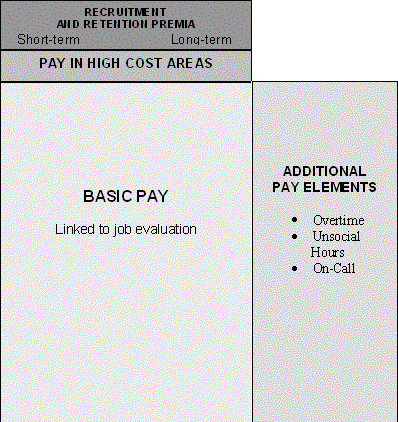
The diagram in Annex A illustrates how some of these key elements fit alongside each other.
A. Job Evaluation and Basic Pay
Under the new system, basic pay will be determined on the basis of job weight. Job weight will be assessed using a new NHS job evaluation scheme, which measures 16 factors covering:
the knowledge and skills required to do the job;
the responsibilities involved;
the physical, mental or emotional effort required and any extra demands imposed by the working environment.
Measuring jobs in this way will capture most aspects currently recognised by paying leads and allowances. Where this is the case, these leads and allowances will be discontinued and the associated resources recycled to help give higher levels of basic pay.
The new pay system will introduce eight common pay bands, placed upon two pay spines – one pay spine for staff covered by the Review Body for nurses and other health professionals, the other for non-Review Body staff. Each pay band has a corresponding range of job evaluation scores, so that similarly weighted jobs are grouped into the same pay band. The highest pay band is divided into four pay ranges. A member of staff’s pay band (or pay range) will be determined solely by job weight. This meets one of the fundamental design requirements of the new pay system, which is to ensure fair pay and support the principles of equal pay for work of equal value.
Figure 1 below shows the new pay band structure, with pay levels expressed at current 2002-03 levels. To provide underlying stability during the transition to the new system, the proposed package includes a pay uplift worth 10 per cent over three years. The value of the new pay bands will therefore be increased by 3.225 per cent in April 2003 and again in April 2004 and April 2005.
The overall NHS pay system can in future be regarded as having three pay spines – the pay bands in spines two and three are shown in Figure 1. Spine 1 is effectively a further pay spine for doctors and dentists. There will be new safeguards to ensure that pay arrangements for staff with comparable job weights – whether they are on the same or on different pay spines – are consistent with equal pay principles.
Figure 1
|
Band 1 |
Band 2 |
Band 3 |
Band 4 |
Band 5 |
Band 6 |
Band 7 |
Band 8 |
|||
|
Range A |
Range B |
Range C |
Range D |
|||||||
|
10,100 |
||||||||||
|
10,450 |
||||||||||
|
10,800 |
10,800 |
|||||||||
|
11,100 |
11,100 |
|||||||||
|
11,400 |
||||||||||
|
11,750 |
||||||||||
|
12,100 |
||||||||||
|
12,450 |
12,450 |
|||||||||
|
12,900 |
12,850 |
|||||||||
|
13,400 |
13,400 |
|||||||||
|
13,700 |
||||||||||
|
14,100 |
||||||||||
|
14,550 |
14,550 |
|||||||||
|
14,900 |
14,900 |
|||||||||
|
15,450 |
||||||||||
|
16,000 |
||||||||||
|
16,500 |
||||||||||
|
17,000 |
17,000 |
|||||||||
|
17,500 |
17,500 |
|||||||||
|
18,000 |
||||||||||
|
18,600 |
||||||||||
|
19,200 |
||||||||||
|
19,750 |
||||||||||
|
20,300 |
20,300 |
|||||||||
|
21,100 |
21,100 |
|||||||||
|
22,000 |
22,000 |
|||||||||
|
22,900 |
||||||||||
|
23,700 |
||||||||||
|
24,500 |
24,500 |
|||||||||
|
25,300 |
25,300 |
|||||||||
|
26,200 |
26,200 |
|||||||||
|
27,500 |
27,500 |
|||||||||
|
28,300 |
||||||||||
|
29,200 |
||||||||||
|
30,200 |
||||||||||
|
31,250 |
31,250 |
|||||||||
|
32,300 |
32,300 |
|||||||||
|
33,600 |
||||||||||
|
34,900 |
||||||||||
|
36,400 |
36,400 |
|||||||||
|
37,500 |
37,500 |
|||||||||
|
39,400 |
||||||||||
|
41,600 |
||||||||||
|
43,800 |
43,800 |
|||||||||
|
45,000 |
45,000 |
|||||||||
|
47,000 |
||||||||||
|
49,200 |
||||||||||
|
52,500 |
52,500 |
|||||||||
|
54,000 |
54,000 |
|||||||||
|
56,250 |
||||||||||
|
59,000 |
||||||||||
|
62,000 |
||||||||||
|
65,000 |
||||||||||
In order to support the transition to the new system, evaluations of common NHS jobs – known as ‘job profiles’ – are being finalised on a national basis. Where a job fits one of these job profiles, it will be possible to place it directly in the appropriate pay band. Where a job does not fit any of the profiles, trained local job evaluators drawn from both management and staff sides will carry out a job evaluation. The aim is to keep to a minimum the number of jobs that require separate evaluation when it comes to national implementation in October 2004.
B. Pay Progression and the Knowledge and Skills Framework
Each pay band or pay range will have a number of points. Each year, staff who are below the maximum point of their pay band or pay range will have a normal expectation of progressing to the next highest point. To help ensure consistency in staff development, there will be two points in each pay band – known as gateways – at which there will be an assessment of the knowledge and skills that staff are applying in their jobs. Pay progression at the two gateways will be linked to the demonstration of applied knowledge and skills. The necessary arrangements will be put in place locally, including support for managers and staff and a robust monitoring system to ensure fairness and consistency. The values of these points increase in steps of around 3 per cent.
The first gateway in each pay band will be after one year in post. The second gateway will vary between pay bands as follows:
|
Pay band |
Position of second gateway |
|
Pay band 1 |
Before final point |
|
Pay bands 2-4 |
Before first of last two points |
|
Pay bands 5-7 |
Before first of last three points |
|
Pay band 8, ranges A-D |
Before final point |
To support personal development and career progression, there will be a new Knowledge and Skills Framework, linked to annual development reviews and personal development plans. The aim is that all staff should:
have clear and consistent development objectives
be helped to develop in such a way that they can apply the knowledge and skills appropriate to their level of responsibility
be helped to identify and develop knowledge and skills that will support their career progression.
This is a major step forward for the NHS and it will need to be introduced carefully and sensitively. The full Knowledge and Skills Framework and associated guidance, which will be used to develop this approach in the ‘early implementer’ sites, will be published ahead of the consultation phase.
C. Pay in High Cost Areas
The new system will include provisions to allow extra pensionable pay for staff who work in high cost areas. The initial focus will be on the areas in and around London, but the new system could in principle be applied to other high cost areas in future.
For staff who work in London and the Fringe areas, the new system will introduce harmonised allowances to replace London weighting, Fringe allowances and Cost of Living Supplements. The allowances will be expressed as a proportion of basic pay (including the value of any long-term recruitment and retention premium), but subject to a minimum and maximum level of extra pay as follows:
|
% of basic pay |
Minimum |
Maximum |
|
|
Inner London |
20% |
£3,000 |
£5,000 |
|
Outer London |
15% |
£2,500 |
£3,500 |
|
Fringe |
5% |
£750 |
£1,300 |
These harmonised arrangements will mean significant extra investment in London pay, with clear gains for most staff. In the minority of cases where existing staff currently have higher levels of London allowance or Fringe allowance, this will be reflected in the arrangements for protection (see section G below).
Outside London and the Fringe areas, the Cost of Living Supplements payable to qualified nurses and some allied health professionals will be converted into recruitment and retention premia (see section D below).
As part of implementing the new system, extra resources will also be made available to NHS organisations in the areas currently covered by Cost of Living Supplements to help address particular recruitment and retention pressures.
D. Recruitment and Retention Premia
Under the new system, NHS organisations will be able to make additional payments to particular staff groups (over and above the basic pay they receive by virtue of job weight), where these payments are needed to recruit or retain sufficient numbers of staff as a result of external labour market pressures. The full package will set out the process and criteria for awarding these recruitment and retention premia.
There will be two types of recruitment and retention premia, depending on whether the labour market pressures being addressed are expected to continue in the longer run or to be relatively short-term:
long-term recruitment and retention premia will be pensionable and will be taken into account when calculating the level of unsocial hours payments, on-call payments, overtime and high cost area payments
short-term recruitment and retention premia will not be pensionable and will usually be awarded for a time-limited period.
Where there are widespread recruitment and retention pressures affecting a particular group of staff, premia may be decided on a national basis on the recommendation of the Review Body or the new Pay Negotiating Council for non-Review Body staff (see section H below).
The total value of a recruitment and retention premium will not normally exceed 30 per cent of basic salary.
There are a number of types of NHS job where external labour market pressures already exist across large parts of the UK. In these cases it has been proposed that employers may apply long term recruitment and retention premia from the outset and that there should be guidance to ensure that the levels of these premia are at least sufficient to prevent any reduction in earnings when staff move to the new system.
E. Hours of the Working Week, Overtime and Annual Leave
In line with the overall aims of harmonisation and consistency with equal pay principles, the new system will introduce standardised arrangements for certain core terms and conditions, including hours, overtime and annual leave.
For all newly appointed full-time staff, there will be a standard working week of 37½ hours. For existing full-time staff whose current contracted hours are below this level, standard hours of 37½ will be introduced on a phased basis (see protection arrangements in section G). Pro rata arrangements will apply to part-time staff.
There will be a phased reduction of hours for full-time staff whose current contracted hours are above 37½ hours, as set out below (with pro rata arrangements for part-time staff). During this two-year period, staff may be required to work up to their old contracted hours (with overtime payable for any hours in excess of their standard hours).
|
Current contracted hours |
New contracted hours |
|
Up to 39 |
37½ from the date of implementation |
|
More than 39, up to 41 |
39 after twelve months 37½ after 24 months |
|
More than 41 |
40½ from the date of implementation 39 after twelve months 37½ after 24 months |
All staff in pay bands 1-7 will be eligible for overtime payments. There will be a single harmonised rate of time-and-a-half for all overtime, with the exception of work on Bank Holidays which will be paid at double time.
All staff will receive the same entitlements to annual leave as follows. These entitlements incorporate the current extra statutory days or extra public holidays, which will no longer apply.
|
Length of service |
Annual leave |
|
Up to five years |
27 days |
|
Between five and ten years |
29 days |
|
More than ten years |
33 days |
A new Terms and Conditions Handbook will be available before the beginning of consultation. It will set out the harmonised arrangements for these and other core terms, together with good practice guidance on areas that are for local flexibility.
F. Payments for Working outside Normal Hours and On-Call Duties
Most NHS staff who work outside normal hours currently receive pay enhancements for doing so, but the arrangements vary widely from group to group. The new system will introduce harmonised arrangements for recognising work of this kind. These arrangements are designed to recognise different types of working patterns, support staff who wish to work flexibly, and allow full scope for employee-led rostering.
There will be pay supplements for all working patterns that involve significant levels of work that take place at the following times:
for staff in pay bands 1-7: before 7.00 am or after 7.00 pm Monday to Friday, and on Saturdays, Sundays or Bank Holidays
for staff in pay band 8: before 7.00 am or after 10.00 pm Monday to Friday; before 9.00 am or after 1.00 pm on Saturdays and Sundays; and on Bank Holidays.
These pay supplements will be calculated on the basis of the average amount of work that a member of staff is expected to undertake over a defined period. This will be translated into a fixed percentage supplement to his or her basic salary, as follows:
|
Average Hours Worked in Defined Periods |
Value of Supplement as Percentage of Basic Salary |
|
|
Bands 1-7 |
Band 8 |
|
|
Up to 5 |
By local agreement |
|
|
More than 5, up to 9 |
9% |
9% |
|
More than 9, up to 13 |
13% |
10% |
|
More than 13, up to 17 |
17% |
10% |
|
More than 17, up to 21 |
21% |
10% |
|
More than 21 |
25% |
10% |
This banding system will mean that staff working broadly similar numbers of hours in the defined periods will receive the same level of supplement, but small variations in these hours will not typically change the level of the supplement. There will be arrangements to monitor working patterns and adjust the level of supplement for future periods if there is a significant change in a member of staff’s working pattern.
There will also be harmonised arrangements to recognise on-call duties. Staff who have to be available to provide on-call cover outside their normal working hours will receive a fixed pay supplement, based on the number of defined periods when they are on-call.
|
Frequency of On-Call |
Value of Supplement as Percentage of Basic Pay |
|
1 in 3 or more frequent |
9.5% |
|
Between 1 in 4 and 1 in 6 |
4.5% |
|
Between 1 in 7 and 1 in 9 |
3.0% |
|
Between 1 in 10 and 1 in 12 |
2.0% |
|
Less frequent than 1 in 12 |
By local agreement |
Staff who are called into work during a period of on-call will receive recompense for the actual work done.
G. Implementation, including Assimilation and Protection
The new system has been designed to ensure that as many staff as possible move to pay bands that provide a higher maximum pay than now, whilst ensuring a phased approach that is consistent with affordability.
Assimilation rules will depend on a member of staff’s basic pay immediately before assimilation (including any leads and allowances that are to be consolidated into basic pay), compared with the minimum and maximum of his or her new pay band.
Where basic pay before assimilation is between the new minimum and maximum of the new pay band, staff will assimilate to the next equal or higher pay point in the new pay band. They may therefore make modest gains immediately on assimilation. But in most cases the full benefit of any higher maximum pay will arise over time as staff progress through their new pay band towards the new maximum.
Where basic pay before assimilation is below the new minimum, staff in pay band 1 will all move straight onto the minimum. Staff in other pay bands will assimilate either at the new minimum or, if they are significantly below the minimum, onto proposed transitional points. These transitional points will be removed once assimilation is complete. There will be special arrangements to ensure that staff reaching retirement age are able to reach at least the new minimum of their new pay band.
In a minority of cases, basic pay before assimilation will be above the maximum of the new pay band. In several cases, this situation has been addressed by agreeing that it is appropriate to pay a recruitment and retention premium (see section D) from the outset. Where the difference remains, pay protection will apply.
The pay protection arrangements will operate by taking into account:
the level of basic pay before assimilation
the level of any London weighting or Fringe allowances, including Cost of Living Supplements in these areas
the average payments from any shift allowances and unsocial hours payments during a prior reference period
leads and allowances measured within the job evaluation scheme.
Where the combined value of these payments is greater than the combined value of the equivalent payments under the new system, the former level of pay will be protected with the annual pay uplift due in 2004 for staff in early implementer sites and in 2005 for staff in the national roll-out. After this pay will be protected for a further 5 years on a mark-time basis (i.e. no annual uplifts) or until the protected amount is overtaken by the new pay band maximum.
There will be phased protection arrangements, as below, for full-time staff whose current standard hours are below 37½ and for part-time staff on an equivalent pro rata basis. These arrangements will continue to apply where staff move post during the protection period.
|
Current full-time standard hours |
Protection arrangements |
|
37 hours |
|
|
36½ hours |
|
|
36 hours |
|
|
35 hours |
|
|
33 hours |
|
There will be a five-year protection period for annual leave entitlements that exceed the new standardised entitlements set out in Section E above. This protection will continue to apply where staff move post during the protection period.
There will also be transitional arrangements to ensure appropriate protection for staff moving from special local arrangements for on-call and stand-by.
H. National Structures
A new body called the NHS Staff Council will be established in 2003 to oversee the operation of the new pay system and to have responsibility for NHS-wide terms and conditions of service. This body will replace the relevant functions of the General Whitley Council and the separate functional Whitley Councils.
There will be a single pay negotiating council for NHS staff (with the exception of the most senior managers) who are not covered by one of the two NHS Review Bodies. This council will replace the relevant functions of the Whitley Councils covering non-Review Body staff.
The remit of the Review Body for Nurses, Midwives, Health Visitors and the former Professions Allied to Medicine (the NPRB) will be expanded to include a wider number of qualified health professionals and their support staff.
Conclusion
The information given in this summary does not itself constitute the full package, and in particular it does not contain enough information to give reliable advice on where staff in particular posts will assimilate in the new system. More detailed information on what the proposals mean for staff will be made available over the next month and the full package will be published by January ahead of staff side consultation on the new pay system.
We hope the summary is nonetheless useful in giving an introduction to the new system and in stimulating discussion and debate locally in the NHS about the benefits this will offer for NHS patient services and for NHS staff.
‘Agenda for Change’
Central Negotiating Group
ANNEX A
Under the emerging new system, the key elements described above can be regarded as fitting alongside each other as shown below.
EARLY IMPLEMENTER SITES
James Paget Healthcare NHS Trust
Guy’s and St Thomas’ Hospital NHS Trust
City Hospitals Sunderland NHS Trust
Papworth Hospital NHS Trust
Aintree Hospitals NHS Trust
Avon and Wiltshire Mental Health Partnership NHS Trust
South West London and St George’s Mental Health NHS Trust
West Kent NHS and Social Care Trust
Herefordshire NHS Primary Care Trust
Central Cheshire Primary Care Trust
North East Ambulance Service NHS Trust
East Anglian Ambulance NHS Trust