A PERMACULTURE ALLOTMENT?
In 'Permaculture In A Nutshell', Patrick Whitefield writes; "Permaculture design is about wholes- if somebody tells you their farm or garden is basically conventional but there is a bit of permaculture on it, they are mistaken."
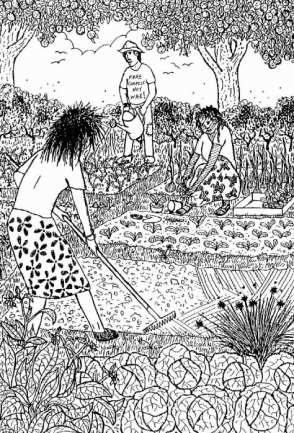
I describe our allotment as 'permaculture', but there's not much that differentiates it from a standard 'organic' plot in many ways- I use techniques that are appropriate for my situation- bed systems, perennial plants in the form of fruit bushes & herbs, recycling urban waste & junk in useful ways (plastic bottles used as cloches and irrigators, reclaimed floorboards as bed edging, old 'internet trial' CD's as bird scarers, etc). I've got a shed built out of scrap timber found on skips, and use old baths, cisterns and bits of plumbing for water harvesting. A pond has been dug and flowers planted to attract pest predators such as frogs, ladybirds and hoverflies, and I grow comfrey as a liquid feed... So do many of the other organic (and even non organic) plot holders who have never heard of the 'P' word. I havn't got a herb spiral or a log with mushrooms on it, and I've largely abandoned (at least for the last couple of years) permaculture 'holy cows' like no dig/sheet mulch beds because in our current damp conditions they are nothing but slug- party venues. They love 'em, and from the rate they multiply, find 'em a total turn on too!
So what makes this allotment 'permaculture'? I'd say because it fits into a broader system/design of trying to create a more sustainable lifestyle in an urban situation; It links in with being vegan (it takes 500 litres of water to grow a kilo of potatoes and 10,000 litres to produce a kilo of beef, and meat and dairy farming accounts for 85% of current land use), with activities like promoting Local Agenda 21 and community building, being part of a LETS system, supporting local organic food outlets & farmer's markets rather than supermarkets, living without a car, creating green space and wildlife friendly environments in a large town, being accountable about fossil fuel use, and trying to support ourselves by means of 'right livelihood’. Our allotment is about being a good place to take the kids or drink a beer, to generally develop awareness and reclaim responsibility for the production of at least some of the food that we eat. We're by no means self sufficient, but some years we grow quite a bit of veg, others less. I've got a full time job, and a full time family, and last year the allotment was far more about being a therapeutic place to chill out than trying to maximise (quantifiable) yields. In fact in terms of potatoes, tomatoes, onions, carrots, cabbages or runner beans, my 'outputs' are probably less than more 'conventional' plots (though we're still wading through a cupboard full of last year's blackcurrant jam!). But in OVERALL 'yield' terms, what I get out of the allotment is immeasurable. Relaxation, fresh air, exercise, observation, wisdom, socialising, spotting a frog amongst the beans...
So when I'm asked to show off what makes my plot so 'different', I can't really because where it's 'different' is more about the 'invisible structures'.
Permaculture has been dismissed as 'all theory' by those demanding to see data and records- to me this is largely missing the point. Looking to measure the outputs of permaculture systems in purely numerical/quantifiable terms in order to prove or disprove that they are a viable alternative to 'conventional' practices makes the mistake of seeing permaculture as a bunch of techniques rather than a holistic design & ethical philosophy... What works in one situation would be a total mistake in another. Methods that are appropriate in the outbacks of Australia or home gardens of Kerala are bound to be irrelevant in the 'Cool Temperate' (read damp, windy & miserable) UK...
So 'does Permaculture work?' is a tautological question- Permaculture is BY DEFINITION about what DOES work and is sustainable for future generations in your particular locality, and that suit where you are at in life, whether the land you steward is a 1000 ha forest, a 10 rod allotment or a windowbox. For me, the allotment works.
Last words must go to Sylvia, long suffering Site Manager at Westcliff Land Cultivation Society (in reference to guess whose plot...); "Huh. Permaculture he calls it. Bloody mess I call it...."
Graham Burnett